UK:
UK:  USA:
USA:





Just like the EU, the UK reports on its estimated lost VAT every tax year. HMRCHis Majesty's Revenue and Customs is a non-ministerial department of the UK Government responsible for the collection of taxes. defines the tax gap as “the difference between the amount of tax that should be paid to HMRC, and what is actually paid”.
HMRC publishes an annual ‘Measuring Tax Gaps‘ report, expressing the gap both in cash terms and as a percentage of theoretical tax liabilities.
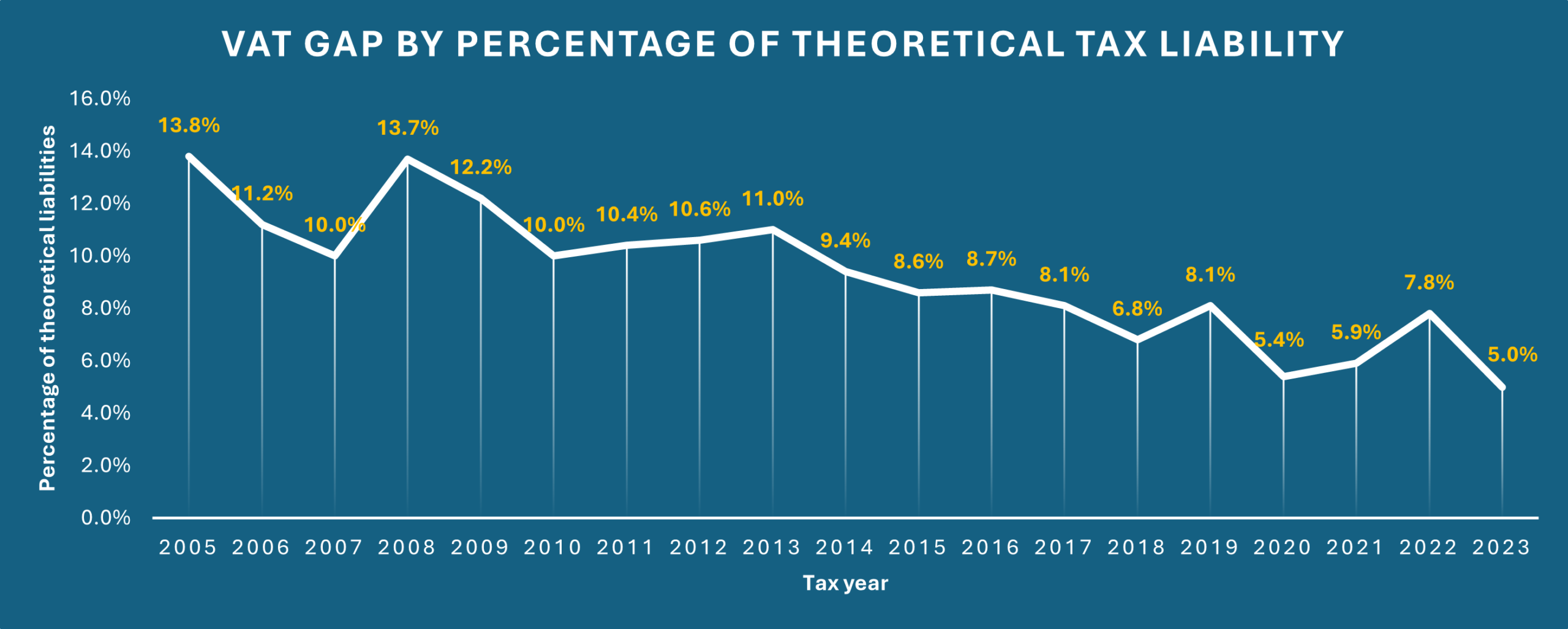
For the 2023 to 2024 tax year, it is estimated the VAT gapThe difference between the amount of VAT revenue due to a tax authority and the amount actually collected was 5.0% (£8.9 billion), a decline from 7.8% (£13.1 billion) in the previous year.
The overall ‘tax’ gap, including income tax, NICs, CGT, VAT, Corporation Tax and other taxes sits at 5.3%, equivalent to approximately £46.8 billion in lost revenue.
In this blog, we are going to focus on the VAT gap.
The UK’s VAT gap history
Over the past decade, the UK’s tax gap has fallen significantly from 13.8% to 5.0% between tax years 2005 to 2006 and 2023 to 2024.
During the COVID-19 pandemic period of 2020-2022, the VAT gap was lower than previous years, falling from 8.1% in 2019 to 5.4% in 2020.
Key takeaways from the report
- Small businesses represent the largest portion of the tax gap (60%).
- Corporation Tax accounts for 40% of the total tax gap.
- Failure to take reasonable care (31%), error (15%) and evasion (14%) are among the main reasons for the overall tax gap.
How does the UK compare internationally?
Whilst international comparisons must be made cautiously as definitions and methodologies vary, the EU recently released their ‘Mind the Gap’ report so it can give us an indication where the UK sits in the rankings.
In 2023, the EU reported a VAT compliance gap of 9.5%, amounting to €128 billion. Across Member States, this ranged from 1% to 30%.
With the UK estimating 5%, it sits on the lower end of the scale between Sweden and Slovenia.
France 5.6%
Latvia 5.4%
Sweden 5.3%
UK 5.0%
Slovenia 4.9%
Portugal 3.6%
Actions to reduce gap
The government is considering a range of measures designed to support HMRC’s efforts to close the VAT gap, including investment, clearer guidelines and penalties designed to deter non-compliance.
One clear way of closing the gap is with better data through e-invoicingElectronic invoicing - widely referred to as e-invoicing - is the exchange of a digital document between a supplier and a buyer. E-invoices are issued, transmitted and received in a structured data format that enabled automatic and electronic processing. They contain data in a machine-readable format so that an AP system can read an invoice without manual data entry, leading to faster and more efficient invoicing.. E-invoicing allows tax authorities to receive invoice data in real time. Continuous monitoring provides governments with a clearer view of economic activity and helps reduce opportunities for misreporting or non-payment.
During the Autumn 2025 Budget, the UK government announced the introduction of mandatory B2B and B2GCommerce between business to government. e-invoicing in 2029.
Authorities believe e-invoicing will trigger a 20% reduction in late payments and increase productivity by 3% in financial sectors.
Alongside digital reforms, the Spending Review 2025 confirmed £1.7 billion additional funding for HMRC over four years, supporting the recruitment of 5,500 compliance and 2,400 debt management staff to help ensure more of the tax due is collected.
Getting the balance right
While reducing the tax gap is a legitimate policy goal, there is a growing recognition that overly aggressive enforcement or compliance policy can have unintended consequences. Increased reporting requirements, stricter penalties and more intrusive compliance activity can raise costs and complexity for businesses.
As the tax gap continues to narrow, further enforcement efforts can become more resource-intensive, prompting organisations such as the OECDOrganisation for Economic Co-operation and Development. The OECD is an international organisation that promotes economic growth, social progress, and environmental sustainability through data, analysis, and policy advice. It has 38 member countries and focuses on topics like climate change, artificial intelligence, and gender equality and IMF to highlight the value of balance, rather than viewing the tax gap as a standalone performance metric.
The latest figures show the UK has made real progress in reducing its VAT gap, putting it among the stronger performers internationally. That said, with £8.9 billion in VAT still going uncollected each year, there is clearly more to do. The challenge now is finding the right balance.
As investment in HMRC increases and the UK moves towards mandatory e-invoicing, the emphasis is shifting away from retrospective checks and towards greater transparency in real time.