UK:
UK:  USA:
USA:





Indirect taxes, such as VAT, GST, or Sales and Use Tax, are designed to be efficient and broad-based. In practice, however, compliance can be highly complex, and even minor missteps can lead to severe penalties and unexpected financial consequences.
Where compliance is most challenging:
Brazil – More than just ICMS
Brazil is well known for being the most complex indirect tax jurisdiction in the world, not only because of ICMS but because several layers of indirect taxes apply at the same time. Businesses must navigate federal, state and municipal rules, often conflicting with one another, which makes compliance particularly challenging.
The key indirect taxes include:
- ICMS (Imposto sobre Circulação de Mercadorias e Serviços), a state VAT on goods and some services, with rates that usually fall between 17% and 20% but vary by state.
- IPI (Imposto sobre Produtos Industrializados), a federal excise duty on manufactured goods, with rates from 0% up to 300% depending on product classification.
- PIS and COFINS, federal social contributions applied to revenue, usually 1.65% and 7.6% under the non-cumulative regime.
- ISS (Imposto Sobre Serviços), a municipal services tax, is charged by more than 5,000 municipalities at rates between 2% and 5%.
The result is a system that places significant demands on businesses. A single transaction can be subject to more than 60 different tax obligations. Real-time e-invoicingElectronic invoicing - widely referred to as e-invoicing - is the exchange of a digital document between a supplier and a buyer. E-invoices are issued, transmitted and received in a structured data format that enabled automatic and electronic processing. They contain data in a machine-readable format so that an AP system can read an invoice without manual data entry, leading to faster and more efficient invoicing. (NF-e) is compulsory across the country, and penalties for late or incorrect invoices are often around BRL 1,000 each. Broader fines can reach 100% of the tax due, and audits are frequent and thorough.
It is this combination of overlapping taxes, strict reporting requirements and severe penalties that makes Brazil one of the most challenging indirect tax environments globally.
India – GSTGoods and Services Tax 2.0
India’s GST regime, introduced in 2017, is undergoing significant reform but enforcement has become increasingly rigorous.
-
Oversight heightened by tech: The GST Council is rolling out GST 2.0, aiming to reduce rates from four to two, 5 % and 18 % while beefing up enforcement. Changes are expected before Diwali (late October 2025)
-
Stricter filing standards: Since July 2025, taxpayers can no longer edit auto‑populated liabilities in the GSTR‑3B return; corrections must go through GSTR‑1A and may delay Input Tax Credit (ITC) for buyers.
-
Enforcement and amnesty: Authorities are offering amnesty for small vendors caught by UPI‑based notices; relief is being considered for those registering in response. Meanwhile, Delhi has recorded GST collections of INR 15,535 crore in the first four months of FY 2025–26, boosted in part by reform and an amnesty scheme that generated INR 218 crore.
-
Fraud consequences: Authorities have pursued enforcement actions, including arrests. For example, in Mumbai, two company directors were arrested for GST evasion using fake ITC claims totalling INR 50 crore (~£4.8 million) between June 2020 and June 2025.
United States – Sales & Use Tax
In the US, indirect tax is often more fragmented than punitive but the penalties themselves can be draining:
-
Multiplicity of Jurisdictions: More than 12,000 state and local tax districts, each with unique rules, exemptions, and thresholds.
-
Economic Nexus: Under South Dakota v. Wayfair (2018), remote sellers may now be required to register after $100,000 in sales or 200 transactions in a state.
-
Penalties: California imposes a 10 % penalty plus interest on late filings, and New York can impose up to 200 % of the underpaid tax and pursue fraud criminally. In some states, business owners face personal liability for unpaid sales tax.
European Union – Real-time reporting, real-time risk
EU member states may share a VAT structure, but enforcement is local:
-
Widespread e‑invoicing: Over 40 new or amended e‑invoicing/VAT rules rolled out across member states as of 1 January 2025.
-
Factsheets published: The European Commission released 2025 e‑Invoicing Country Factsheets in July, covering all 27 EU states and 4 EEA countries, detailing each country’s mandates and timeline.
-
Notable penalties:
-
Italy: Mandatory electronic invoicing (SDI) for most B2B and B2C; non‑compliance can lead to fines of 90–180 % of VAT due.
-
Spain: Invoice data must be submitted within 4 days under the SII system; delays carry penalties of 0.5 % of the invoice value, with a minimum of €300.
-
Hungary: Stricter e-invoicing validation rules, originally due 1st July, now postponed to 15 September 2025; unchecked invoice validation is reclassified as an error, blocking submissions and risking penalties.
-
Real‑time systems are shrinking the “VAT gap”: between 2020 and 2021, the EU’s VAT gap dropped by €38 billion thanks to digital controls.
China – Digital precision
China’s VAT system is technologically advanced:
-
Golden tax software: VAT invoices (fapiao) must be issued via certified software; internal invoices are not allowed.
-
Credit matching: Input tax credits only apply when digital fapiao match output invoices exactly.
-
Penalties: Misuse of fapiao can lead to fines of up to 5 times the tax amount, with potential legal consequences.
Stay compliant or pay the price
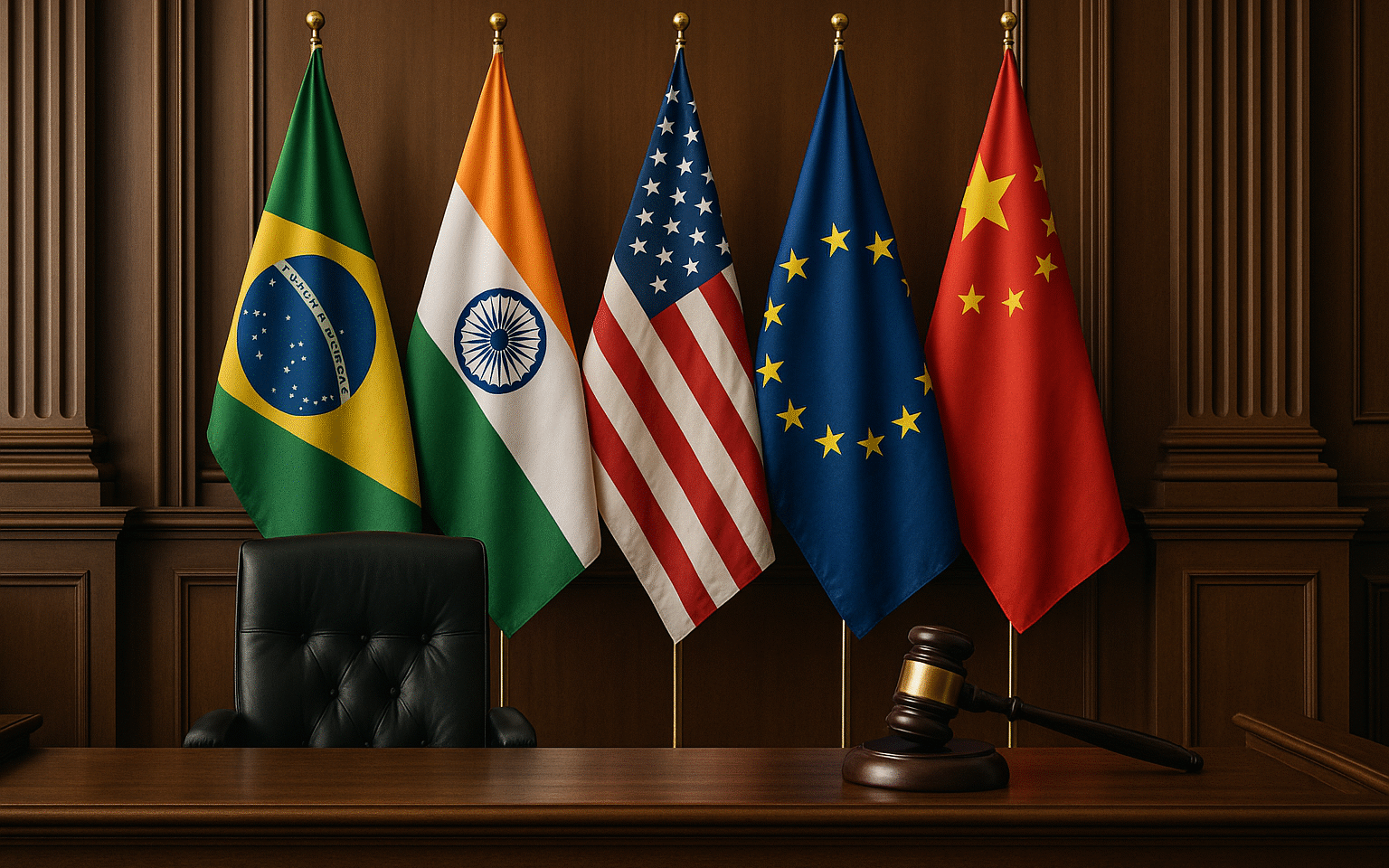
These jurisdictions impose indirect-tax frameworks that are not just complex; they are among the most demanding. Brazil’s layered ICMS system, India’s near-real-time GST enforcement, the US’s multi-jurisdictional structure, Europe’s expanding digital reporting, and China’s highly precise fapiao system all demand precision, expert systems, and a proactive approach to compliance.
If your business is navigating VAT, GST or Sales and Use Tax in these tough jurisdictions, the risks can be significant. If you need help staying compliant, speak to Innovate Tax to find out how our expertise can support you.